

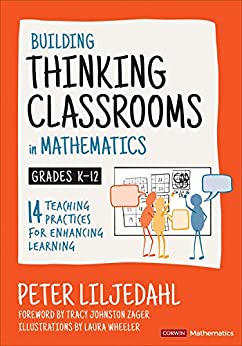
Peter Liljedahl’s “Building Thinking Classrooms in Mathematics, Grades K–12: 14 Teaching Practices for Enhancing Learning” is a transformational guide that opens up a new horizon in the field of mathematics education. And although I am not a maths teacher, but as an educator and a voracious reader, I found this book to be more than just an instructional manual—it is a game-changer in the way we approach teaching in general.
Liljedahl’s guide is a culmination of his 15 years of thorough research, crystallized into 14 optimal practices that strive to move classrooms away from rote learning and repetitive calculations.
What I found particularly fascinating about this book is its ability to provide a vivid, practical picture of how these 14 practices can be implemented and progressively built upon throughout the year. Liljedahl has organized these into four toolkits, each forming a necessary building block for the subsequent one, ensuring a steady learning curve for educators.
Liljedahl also includes rich tasks, macro moves, and micro moves to facilitate the transition to a thinking classroom. As an educator, this gave me an array of techniques to draw from and immediately implement in my teaching practice.
[Related: Best Books for Math Teachers]
Additionally, the inclusion of teacher and student interviews, as well as student work samples, adds a tangible and relatable aspect to the guide, allowing us to visualize the potential impact of these practices.
Liljedahl strongly advocates for the creation of a ‘thinking classroom’, a learner-centered environment where students are actively engaged in deep mathematical thinking and learning. The transformative potential of this book struck a chord with me; it is compelling and truly groundbreaking.
Liljedahl’ s teaching philosophy, as I come to see it, is theoretically grounded within experiential learning and the social constructivist paradigm where the student-centered learning approach is the main catalyst of classroom learning.
Reading “Building Thinking Classrooms in Mathematics” was indeed a rewarding experience. The book serves as a robust catalyst for change, empowering educators like myself to foster a nurturing environment conducive to deep mathematical exploration and comprehension.
This book stands as a testament to the need for transformation in the field of mathematics education, and I highly recommend it to fellow educators. The techniques laid out by Liljedahl, if employed effectively, hold the power to change the way students view and interact with mathematics, making it a vibrant, thought-provoking subject rather than a series of numbers and equations to be memorized.
Building Thinking Classrooms Book Club Questions
Here are some thought-provoking book club questions for “Building Thinking Classrooms“:
- What were your initial impressions of Liljedahl’s concept of a “thinking classroom”? How did your perspective evolve as you delved deeper into the book?
- How did you find Liljedahl’s 14 practices for enhancing learning? Were there any that particularly resonated with your current teaching practices, and why?
- Can you identify any practices that you believe would be challenging to implement in your classroom? How might you approach these hurdles?
- Liljedahl discusses the role of institutional norms and habits in fostering a “non-thinking” classroom environment. Have you observed this in your own teaching experience? How do you plan to counteract these norms?
- The book includes interviews with teachers and students, as well as student work samples. How did these real-life examples influence your understanding and acceptance of the strategies presented?
- The author suggests implementing the practices in a certain order and building on them throughout the year. How would this model fit into your current curriculum planning? What adjustments might you need to make?
- Did the inclusion of macro moves, micro moves, and rich tasks offer practical, feasible techniques for you to implement in your teaching practice?
- How did this book challenge your pre-existing ideas about teaching and learning mathematics?
- In what ways do you believe your students will benefit from the implementation of these practices?
- After reading this book, how do you envision the future of your mathematics classroom? What steps will you take to transform your classroom into a thinking classroom?
I hope you find Building Thinking Classrooms in Mathematics summary helpful!