


Symbolic interactionism offers a distinctive way of understanding human society. The perspective begins with a simple but powerful premise: people act toward things based on the meanings those things hold for them, and these meanings emerge through social interaction (Blumer, 1969; Quist-Adade, 2019).
A wedding ring, a raised eyebrow, a job title, a classroom seating arrangement: none of these carry inherent significance. Their meaning develops as people use and interpret them together in everyday situations.
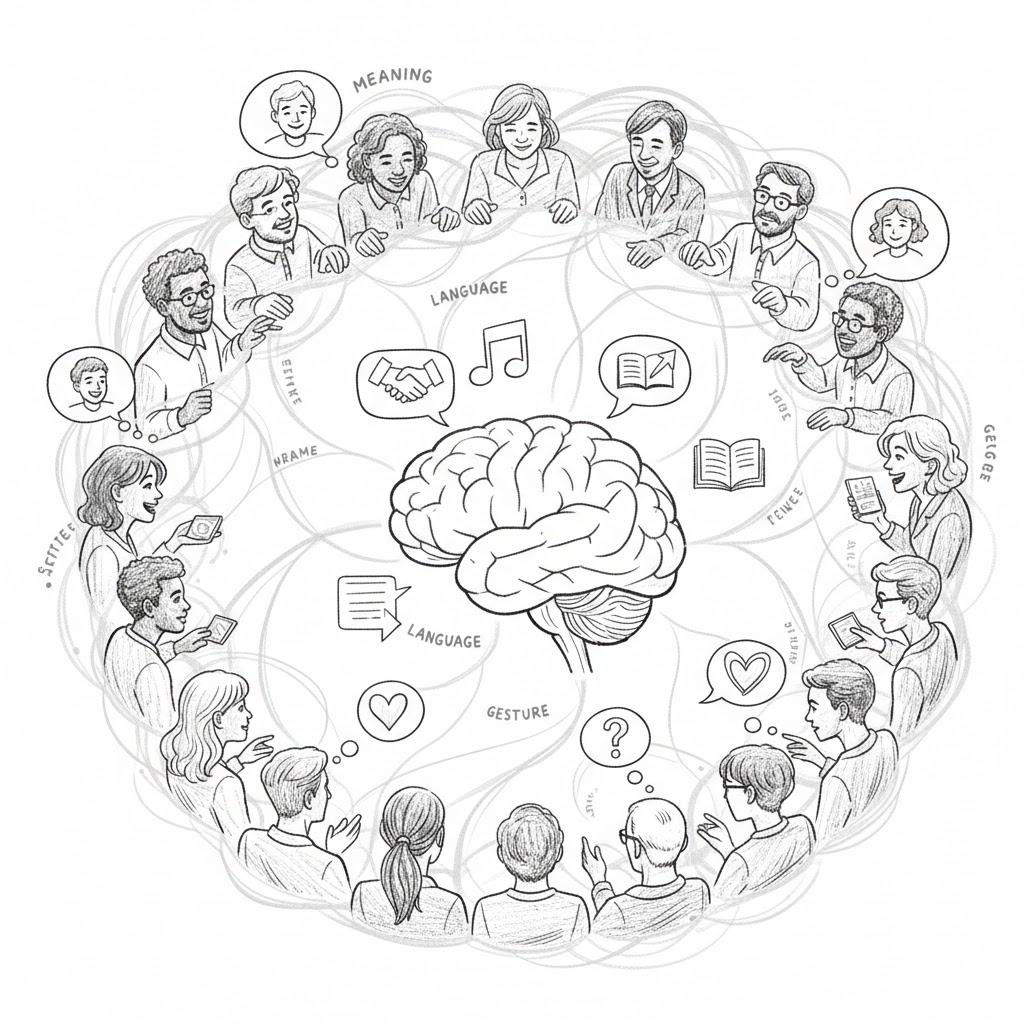
This perspective did not spring from a single thinker. It grew from a rich intellectual lineage that wove together pragmatist philosophy, social psychology, and early sociological theory (Powell, 2013). Charles Horton Cooley, John Dewey, William James, and George Herbert Mead all contributed foundational ideas about how the self, meaning, and action develop through social processes. Their collective insight was that consciousness and identity are not pre-social givens waiting to be expressed. They are accomplishments, formed and reformed through communication with others.
Mead and the Social Self
Mead’s contribution stands as the central theoretical anchor. He argued that the self emerges through interaction, particularly through what he called role-taking: the ability to see oneself from the standpoint of others (Powell, 2013). When children play games, they learn to anticipate how others will respond to their actions. They internalize the attitudes of parents, teachers, peers, and eventually what Mead termed the “generalized other,” a composite sense of how the broader community views situations and conduct.
Mead distinguished between two aspects of the self: the “I” and the “me.” The “I” represents spontaneous, creative impulses. The “me” reflects the internalized expectations of others. This distinction helps explain something we all recognize from daily experience. We act creatively and sometimes unpredictably, yet we remain oriented toward social expectations. The tension between these two dimensions produces the dynamic, reflexive quality of human action (Powell, 2013).
Language plays a crucial role in this process. By speaking and hearing ourselves speak, we become objects to ourselves. We can reflect on our own actions, anticipate consequences, and adjust our behavior. This reflexivity distinguishes human interaction from simpler forms of animal communication (Wang, 2022).
Blumer’s Formalization
Herbert Blumer, working at the University of Chicago, formalized symbolic interactionism as a recognizable sociological perspective during the mid-twentieth century. He articulated three core premises that continue to define the approach. First, humans act toward things based on the meanings those things have for them. Second, these meanings arise from social interaction. Third, meanings are handled and modified through an interpretive process that people use when dealing with the situations they encounter (Blumer, 1969; Carter & Fuller, 2015).
Blumer rejected stimulus-response models of behavior that treated people as passive responders to external forces. For him, human action is always mediated by interpretation. Psychological traits, social roles, cultural norms: all of these matter only as they are taken up, assessed, and adjusted through ongoing interaction (Powell, 2013). Society exists not as a fixed structure imposing itself on individuals, but as a continuous process of joint action. People fit their lines of activity together, moment by moment, in ways that can break down, shift direction, or require redefinition at any point.
This emphasis on process and contingency gave symbolic interactionism a distinctive character. The perspective does not deny the existence of social structures. Institutions, organizations, and patterns of inequality clearly shape human experience. But interactionists insist that these structures are best understood as outcomes of interaction, not as external forces acting upon passive individuals (Quist-Adade, 2019). People both shape and are shaped by society.

Goffman and the Performance of Self
Erving Goffman extended interactionist thinking in influential directions. His dramaturgical approach treats social interaction as performance. When people enter the presence of others, they present themselves in ways designed to shape how the situation is defined and how others respond (Goffman, 1956). We manage impressions through appearance, behavior, and speech, guiding others’ interpretations so interactions unfold in predictable and favorable ways.
Goffman’s insight was that the self is not a fixed inner essence but an effect of interaction. What counts as the “self” emerges from how individuals perform roles and how those performances are received by audiences. Performances rely on what Goffman called “fronts”: combinations of setting, appearance, and manner that provide standardized cues helping audiences interpret the role being performed. A doctor’s white coat, a teacher’s position at the front of the classroom, a manager’s corner office: these fronts become institutionalized, shaping expectations across many situations (Goffman, 1956).
Social life depends on a working consensus. Participants in interaction typically cooperate to maintain a shared, surface-level agreement about what is happening, even when private beliefs or feelings differ. People use defensive and protective practices to sustain this interactional order. We work to protect our own performances, and we often use tact to help others save face when disruptions threaten the smooth flow of interaction (Goffman, 1956).
Related: What is Social Reconstructionism?
Schools and Ongoing Debates
Symbolic interactionism developed into several distinct traditions. The Chicago School, following Blumer, emphasized process, fluidity, and qualitative inquiry. Researchers in this tradition study people in natural settings, observing how meaning, identity, and social order are accomplished in practice (Quist-Adade, 2019). The Iowa School, associated with Manford Kuhn, pushed toward more systematic, empirically testable approaches, using surveys and tools like the Twenty Statements Test to operationalize interactionist concepts (Carter & Fuller, 2015). A third tradition, structural symbolic interactionism developed by Sheldon Stryker, bridges micro and macro levels by examining how identities form through role relationships embedded in larger social structures (Carter & Fuller, 2015).
Contemporary interactionist research spans many domains: deviance, health, gender, emotions, social movements, digital interaction, and identity formation online (Carter & Fuller, 2015). The perspective’s conceptual tools have proven adaptable as social life has shifted into mediated and virtual environments (Wang, 2022). Questions about how people present themselves on social media, negotiate meaning in online communities, and construct identities across digital platforms all draw productively from interactionist insights.
Ongoing debates concern the relationship between micro interaction and macro structure. Symbolic interactionism remains strongest when analyzing face-to-face encounters and the development of the self. Critics have sometimes charged that the perspective underestimates how power, institutions, and historical forces constrain individual action. Yet this tension has also proven generative, pushing scholars to explore how interaction produces and sustains larger social patterns (Carter & Fuller, 2015; Quist-Adade, 2019).
Symbolic interactionism endures because it takes seriously something we all know from experience: meaning matters. How we interpret situations shapes how we act, and those interpretations emerge through our ongoing encounters with others. The perspective reminds us that social reality is not simply given. It is accomplished, moment by moment, through the symbolic work of people making sense of their world together.
References
- Blumer, H. (1969). Symbolic interactionism: Perspective and method. Englewood Cliffs, NJ: Prentice-Hall.
- Carter, M. J., & Fuller, C. (2015). Symbolic interactionism. Sociopedia.isa. https://doi.org/10.1177/205684601561
- Goffman, E. (1956). The presentation of self in everyday life. Edinburgh: University of Edinburgh, Social Sciences Research Centre.
- Quist-Adade, C. (2019). Symbolic interactionism: A brief introduction. In Symbolic interactionism: The basics (pp. 18–40). Wilmington, DE: Vernon Press.
- Powell, J. L. (2013). The development of symbolic interactionism. In Symbolic interactionism (pp. 3–14). New York, NY: Nova Science Publishers.
- Powell, J. L. (2013). Key thinkers. In Symbolic interactionism (pp. 5–22). New York, NY: Nova Science Publishers.
- Wang, L. (2022). A study of symbolic interactionism and communication from the perspective of American social psychology. European Review, 31(3), 213–226. https://doi.org/10.1017/S1062798722000266


