
I am a big fan of John Creswell’s works. I find his research methodology textbooks very practical, to the point, and down right helpful. I already covered some of his works in previous posts namely his popular book Research Design: Qualitative, Quantitative and Mixed Method Approaches. In this post, I introduce you to another of his research methodology books titled Qualitative Inquiry and Research Design:Choosing Among Five Approaches
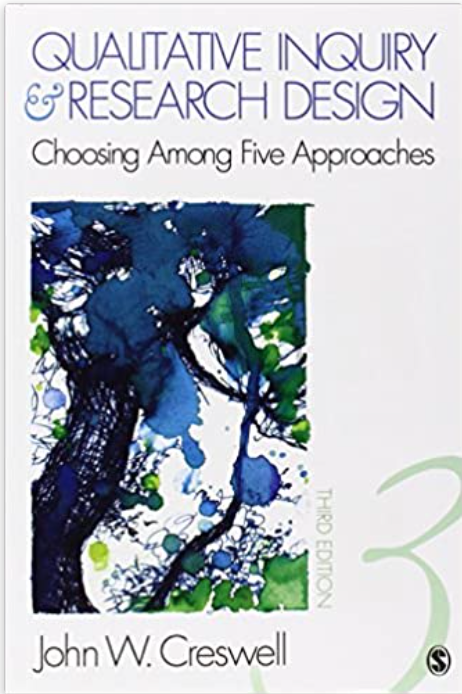
Creswell Qualitative Inquiry and Research Design Book Summary
John Creswell’s “Qualitative Inquiry and Research Design” stands out as an essential volume for both budding and seasoned researchers in the social sciences. With Creswell’s work, there’s a refreshing pragmatism that seems to permeate the text, making it immensely applicable.
In this third edition, Creswell’s contribution to the field of qualitative research is substantial. His exploration into the five principal approaches to qualitative inquiry — narrative, phenomenology, grounded theory, ethnography, and case studies — provides a structured yet flexible framework that researchers can adapt to their specific needs.
Each approach is laid out with meticulous care, underpinned by practical examples that bring abstract concepts to life. Creswell’s narrative approach delves into the personal stories, providing a lens to view experiences sequentially and thus allows the researcher to construct meaning through stories. Phenomenology, on the other hand, digs into the essence of experiences and the meaning people derive from them, a focus that is profound and deeply reflective.
Grounded theory stands out in Creswell’s exposition as an iterative, systematic style of research that builds theory from the ground up. It is presented as a journey towards understanding, starting from data towards abstraction. Ethnography is depicted as an immersive cultural exploration, where researchers are encouraged to observe and interpret the shared patterns of behaviors, language, and actions within a group.
Case studies are perhaps the most integrative, examining a specific ‘case’ within its real-world context. Creswell doesn’t just describe these approaches; he positions them in relation to each other, discussing how they differ in their process from data collection, analysis, and report writing to their standards for validation and evaluation.
What sets this book apart is Creswell’s skill in elucidating the distinct nature of each approach in practice. He provides a comparative view that enables readers to understand how these methodologies can be applied in actual research scenarios, how they differ, and where they might overlap. It’s a book that respects the intelligence of its audience, expecting them to engage critically with each approach, while also offering the necessary guidance to make informed choices.
Reading Creswell, one gets the sense of an academic mentor who is there to guide but not dictate the journey. His book, as a result, does more than instruct — it inspires. It opens up a dialogue with the reader, encouraging them to consider the fit of their research question with the methodology, and to align their personal research interests with the approach that best serves their inquiry.
Final thoughts
For anyone navigating the rich waters of qualitative research, Creswell’s book acts as a compass. It points researchers towards the right questions, equips them with the understanding to select an approach, and prepares them for the intricate task of qualitative research. For educators and students alike, Creswell’s work is not just a textbook but a crucial reference point that embodies the dynamism and diversity of qualitative inquiry.