


In 2016, N.K. Jemisin won the Hugo Award for Best Novel with The Fifth Season. She won again in 2017. And again in 2018. No author in the award’s six-decade history had ever won three consecutive years, and Jemisin did it with a trilogy that shattered every template the genre had relied on: no medieval kingdoms, no European settings, no chosen farmboy with a sword. The Broken Earth trilogy proved that adult fantasy had evolved far beyond the world Tolkien built, even as Tolkien’s influence remained everywhere.
Fantasy fiction for adults now covers an enormous range. Epic sagas with thousands of pages coexist alongside tight standalone novels. Grimdark antiheroes share shelf space with mythological reimaginings and urban wizards solving crimes. The common thread is worldbuilding: every book on this list creates a reality with its own rules, histories, and consequences, and then drops characters into situations where those rules get tested.
Best Fantasy Books and Series for Adult Readers
From foundational classics to modern award-winners, these twelve fantasy books and series reward adult readers with complex characters, layered worlds, and stories that linger long after the last page.
1. The Lord of the Rings, by J.R.R. Tolkien

Tolkien spent twelve years writing this trilogy, drawing on his expertise in Anglo-Saxon and Norse mythology, his experience in the trenches of World War I, and his deep love for the English countryside. The story of Frodo Baggins carrying the One Ring to Mount Doom is the foundation on which modern fantasy was built. Over 150 million copies have been sold worldwide, and nearly every epic fantasy written since owes something to Middle-earth’s maps, languages, and mythic scope.
2. A Game of Thrones (A Song of Ice and Fire), by George R.R. Martin

Martin took the epic fantasy framework and filled it with political realism, moral ambiguity, and the willingness to kill any character at any moment. The series follows multiple noble families fighting for control of the Iron Throne across a continent inspired by the Wars of the Roses. Five volumes have been published since 1996, with two remaining. The HBO adaptation made fantasy fiction a mainstream cultural event and proved that complex, adult-oriented storytelling could draw audiences of millions.
3. The Fifth Season (The Broken Earth Trilogy), by N.K. Jemisin
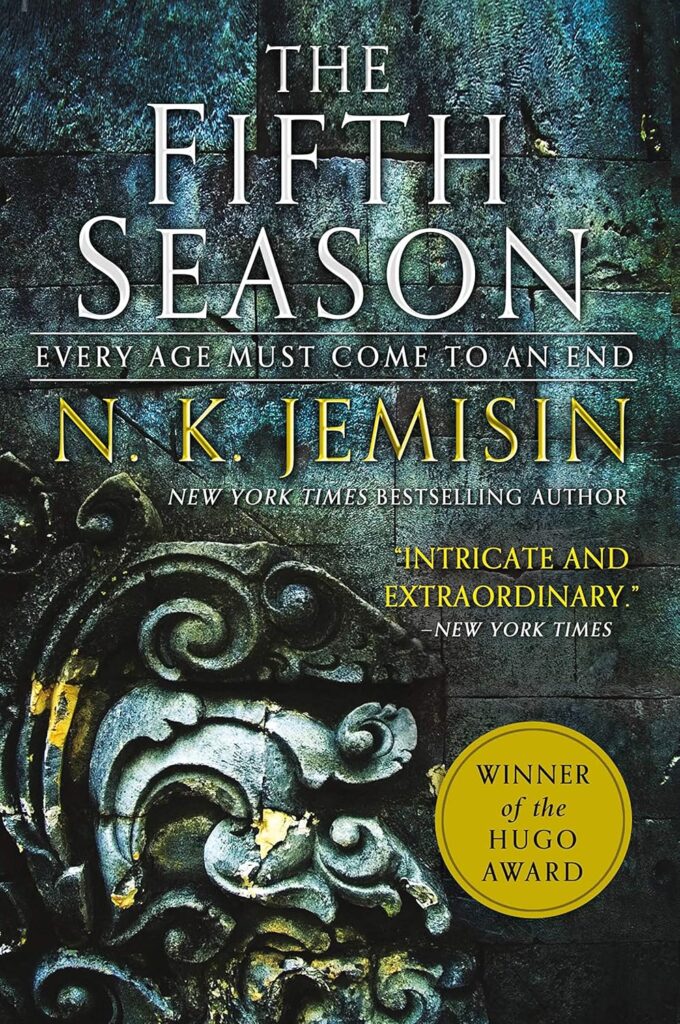
Jemisin’s trilogy is set on a supercontinent plagued by catastrophic seismic events, where people called orogenes can control earthquakes but are feared, enslaved, and brutalized by the society they protect. The first novel is written partly in second person, a bold structural choice that immerses readers directly in the protagonist’s trauma and fury. The trilogy swept three consecutive Hugo Awards and expanded what the genre could say about power, oppression, and survival.
4. The Name of the Wind (The Kingkiller Chronicle), by Patrick Rothfuss

Rothfuss created a story-within-a-story structure: legendary figure Kvothe tells his own life story to a chronicler over three days. The prose is lyrical and precise, and the magic system, called Sympathy, operates on scientific principles that Rothfuss explains with the care of a physics textbook. The book appeared on nearly every best fantasy list compiled in the past decade. Fans continue to wait for the third and final volume.
5. The Wheel of Time, by Robert Jordan

Jordan’s fourteen-volume saga (completed posthumously by Brandon Sanderson) is one of the most ambitious undertakings in fantasy history. The story follows Rand al’Thor, a young man destined to face the Dark One, across a world with deeply layered cultures, a gender-divided magic system, and hundreds of named characters. The series sold over 90 million copies and earned a reputation for rewarding patient readers with extraordinary payoffs in its later volumes.
6. Mistborn: The Final Empire, by Brandon Sanderson

Sanderson asked a simple question: what if the prophesied hero failed and the Dark Lord won? The result is a world of ash, oppression, and rigid class division, where a young street thief named Vin discovers she can ingest and “burn” metals to gain superhuman abilities. The Allomancy magic system is among the most inventive in modern fantasy, with clear rules that Sanderson uses to construct heist-like plot mechanics. The original trilogy is complete, with an expanded series continuing the world’s story.
7. American Gods, by Neil Gaiman

Gaiman’s premise is irresistible: the gods that immigrants brought to America, from Odin to Anansi to Czernobog, still walk among us, diminished and forgotten, facing a war against new deities born from technology, media, and consumption. Ex-convict Shadow Moon gets pulled into this conflict as bodyguard to the mysterious Mr. Wednesday. The novel won both the Hugo and Nebula Awards and became a Starz television series. It reads like a road trip through American mythology, blending folklore with highway diners and roadside attractions.
8. The Blade Itself (The First Law Trilogy), by Joe Abercrombie

Abercrombie became one of the leading voices in grimdark fantasy by writing characters who are deeply, sometimes uncomfortably, human. The First Law follows a crippled torturer, a vain barbarian, and a self-absorbed nobleman through a world where heroism is rare and moral clarity is rarer. The trilogy subverts genre conventions at every turn, and Abercrombie’s dark humor keeps the bleakness from becoming unbearable. Multiple fantasy review sites rank it among the best debuts of the 21st century.
9. A Wizard of Earthsea, by Ursula K. Le Guin

Le Guin published this in 1968, and it remains one of the most beautifully written fantasy novels in the language. Young Ged, a gifted wizard, accidentally unleashes a shadow creature and must chase it across an archipelago world to confront what it truly represents. The novel is compact, philosophical, and deeply influenced by Taoism. Le Guin was one of the first major fantasy authors to center a non-white protagonist, and her Earthsea series has influenced writers from Salman Rushdie to Hayao Miyazaki.
10. The Poppy War, by R.F. Kuang

Kuang drew directly from Chinese history, particularly the Second Sino-Japanese War and the Rape of Nanjing, to build a military fantasy that starts as a school story and becomes something much darker. Orphan Rin aces a national exam, enters an elite military academy, and discovers she can channel the power of gods through shamanism. The novel does not shy away from depicting the consequences of war, and Kuang’s willingness to let her protagonist make devastating choices earned the trilogy critical acclaim and a devoted readership.
11. The Dresden Files, by Jim Butcher

Harry Dresden is a professional wizard listed in the Chicago phone book. He takes cases involving vampires, faeries, demons, and things considerably worse, all set against a modern urban landscape. Butcher has published seventeen novels in the series since 2000, and the books reward long-term readers with an overarching mythology that builds and pays off across volumes. The series is one of urban fantasy’s defining works, blending noir detective fiction with increasingly high-stakes supernatural conflict.
12. The Priory of the Orange Tree, by Samantha Shannon

Shannon wrote a standalone epic fantasy spanning multiple continents and cultures, with an ensemble cast led almost entirely by women. Queens, dragonriders, spies, and mages navigate political alliances and ancient threats in a world where a sleeping evil stirs beneath the earth. At over 800 pages, the novel delivers the scope of a multi-volume series in a single book. It appeared on multiple best fantasy recommendations and earned praise for its inclusive worldbuilding and ambitious scope.
Related: Best Mystery Books: Top Whodunits and Thriller Picks

Conclusion
Fantasy fiction for adults has never been this varied or this ambitious. These twelve books and series represent the genre’s full range, from Tolkien’s mythic foundations to Jemisin’s structural experiments, from Abercrombie’s grimdark cynicism to Gaiman’s mythological road trips. Pick the subgenre that pulls you in, start reading, and clear your schedule. These are not books that let you walk away easily.
References
- Book Riot. (2025). 23 best fantasy book series for adults. https://bookriot.com/best-fantasy-book-series/
- Penguin Random House. (n.d.). High fantasy books. https://www.penguinrandomhouse.com/the-read-down/high-fantasy-books/
- Pan Macmillan. (2025). Best new fantasy books. https://www.panmacmillan.com/blogs/science-fiction-and-fantasy/best-new-fantasy-books
- Fantasy Book Review. (n.d.). Epic fantasy. https://www.fantasybookreview.co.uk/fantasy-sub-genres/epic-fantasy.php
- Reedsy Discovery. (2025). 20 addictive urban fantasy books. https://reedsy.com/discovery/blog/urban-fantasy-books
- Goodreads. (2024). Readers’ favorite fantasy 2024. https://www.goodreads.com/choiceawards/best-fantasy-2024


